The beginning
‘Decolonizing our Practices’, in collaboration with One Future Collective was a journey of reflecting on the politics of mental health practices. The primary intention was to push beyond awareness, reflection and insight oriented practice and to look at therapist and client identity, social locations and tracing the histories of those identities.
For a while now, we have been looking to enter and engage with the intersections of mental health and the justice system. We had initially mapped out a 1 session/ 1 workshop agenda with the hope of exploring this with a group of people. Around the same time, we got introduced to Vandita Morarka (founder and CEO of One Future Collective).
Through a series of zoom calls, we launched on 10th October 2021 in collaboration with One Future Collective. This project involved multiple sharing circles and workshops that were spread out between the months of October to February 2022. In keeping with the theme for World Mental Health Day 2021 (“Mental health in an Unequal world”) we conceptualised this project to recognize that working towards a world that acknowledges the intricacies of care in an unequal society requires more than having brief conversations in isolation.
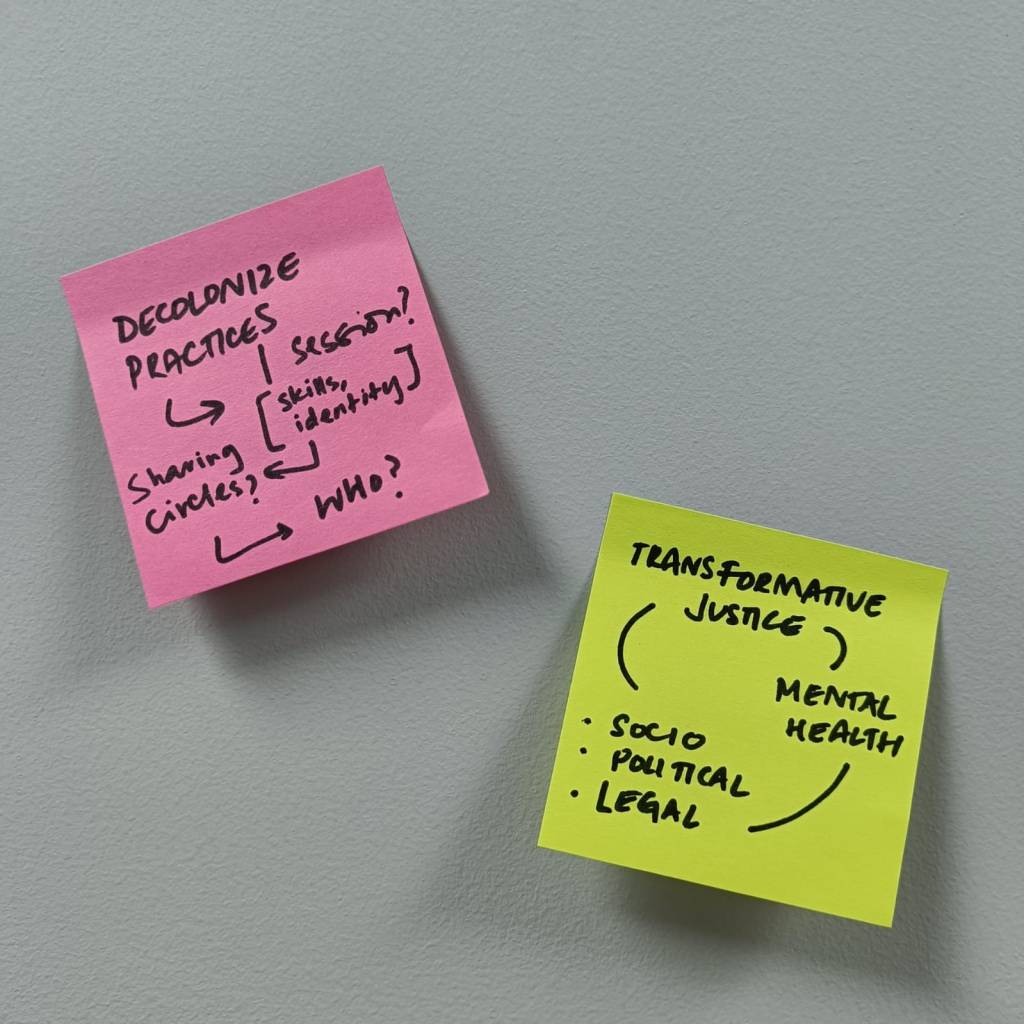
Ahana mapping out our idea darts in the initial stages, before we cleaned the idea board and came to action points through conversations with Vandita and
Anvita.
Meet the collaborators
One Future Collective, is a feminist social purpose organisation with a vision of a world built on social justice, led by communities of care. You can reach out to them through their socials! From the organisation, we got to ideate and co-facilitate with Anvita, their (former) Senior Program Officer. We also had interns from both organisations join us for a part of the project for assistance with logistics, communication and documentation.
Our process
Through the course of a month, we explored multiple modes of facilitating a space on decolonizing our work.
We began with workshops and expanded to a multi-series sharing circle to bring in nuance and depth. These spaces were created in order to bring in the voices of different stakeholders – such as mental health professionals, user-survivors of mental health services and families of persons accessing mental health services. Our hope was to get an understanding of therapeutic services in the mental health world and situate the intersection of therapist and client identity in the politics of mental health work (and therefore training and education) and the impact of this service on people seeking it out.
Each of the sharing circles consisted of mental health professionals (counselling and clinical psychologists, educators, students and researchers) who met thrice to speak about decolonization, contextualising their experience and trainings in politics as well as building systems to support this path of practice. The conversations in the sharing circles were built with care, safety and with respect for differences in practice and experience. A common thread in all the circles was an acknowledgement of discomfort and disconnect with trainings and mental health work in India.
The workshops with user-survivors of mental health held space to reflect on experiences of mental health services and a strong underlying experience that shaped therapy was therapist identity. The participants also reflecting on supporting mental health outside therapy.
Reflections from Team Tangent
For our team, this project pushed the boundaries of work in theory and practice. This project was also executed at the cusp of the pandemic and hearing from people who felt strongly about mental health and politics allowed for the social isolation to limit itself outside of work for a while. This project also saw a lot of reflections on mental health and lockdowns, pandemic, staying home and for professionals – shifting to online work and private practice.
The conversations themselves strengthened with different perspectives, while being grounded in a decolonized stance. The intersection between mental health work and social justice systems found spaces to grow and we found a lot of solidarity in co-creating with a group of professionals every fortnight for a few hours.
The last steps
The sharing circles and workshop highlighted reflexivity as one of the strongest skills required to decolonize mental health work in India. Furthermore, nurturing this skill and navigating through the discomfort that might come up with support and at a pace that works for each person is an integral part of choosing to embark on this journey.
Our sharing circles and workshops came to an end in December. We debriefed our work through follow up conversations with Anvita and creating summaries of our conversations for Instagram. We also co-created resources on decolonizing mental health work and a blogpost recording a conversation on ‘Shifting Away from a Single Narrative of Care’ (you can check out part 1 and part 2).
Links to the summaries – sharing circles 1 , 2 , 3 and workshop.
 Welcome to TangentMHI!